
Petroleum-Spirit
(Carriage by Road) (Jersey) Regulations 2001[1]
PART 1
INTERPRETATION
1 Definitions
(1) In
these Regulations, unless the context otherwise requires –
“ADR” means the European
Agreement concerning the International Carriage of Dangerous Goods by Road
signed at Geneva on 30th September 1957, as revised or re-issued from time
to time;
“Approved Carriage List”
means the list approved and published from time to time by the Health and
Safety Commission of the United Kingdom under Regulation 5(1)(a) of the Carriage
of Dangerous Goods by Road Regulations, 1996 of the United Kingdom;
“Approved Tank
Requirements” means the list approved and published from time to time by the
Health and Safety Commission of the United Kingdom under Regulation 5(1)(c)
of the Carriage of Dangerous Goods by Road Regulations, 1996 of the United
Kingdom;
“approved person” means a person
approved by a competent authority for the purpose of carrying out such
functions in connection with the examination, testing and certification of
tanks as shall be specified by the competent authority in the approval;
“carriage” has the meaning
assigned to it by Regulation 3(1);
“carrying tank” means the
tank or, if there is more than one, tanks on a road tanker designed for the
carriage of goods and does not include a fuel tank;
“competent authority”
means a person or organization in any country which is for the time being a
competent authority for the purposes of –
(a) approving persons to
examine, test and certify tanks;
(b) examining, testing and
certifying tanks; and
(c) recognising standards for
fire extinguishers,
and for Jersey the
competent authority means the Chief Fire Officer;
“container” means a vessel
with an internal volume of not less than one cubic metre which is –
(a) of a permanent character
and strong enough for repeated use;
(b) designed to facilitate
the carriage of liquids, by one or more modes of carriage, without intermediate
reloading;
(c) designed to be readily
handled; and
(d) designed to be easy to
fill and empty,
but does not include any
packaging, a tank, or a vehicle.
“danger sign” means the
sign that is referred to in paragraph 17, and depicted in figure 4,
of Schedule 4;
“emergency action code”
means the code required to be displayed on tanks and vehicles which are being
used for the carriage of petroleum-spirit, ascertained in accordance with the
Approved Carriage List;
“emergency information”
means details of measures to be taken by the driver of a vehicle carrying
petroleum-spirit in the event of an accident or emergency and other safety
information concerning petroleum-spirit, and shall include –
(a) the nature of the danger
inherent in petroleum-spirit and the safety measures to be taken to avert any
such danger;
(b) the measures to be taken
in the event of fire and in particular the fire-fighting appliances or
equipment which must not be used;
(c) the measures to be taken
in the event of breakage of, or damage to, a container containing
petroleum-spirit, particularly where such breakage or damage results in a
spillage of petroleum-spirit on to the road; and
(d) the measures to be taken
to avoid or minimise damage to the aquatic environment in the event of spillage
of petroleum-spirit;
“fuel tank” means a tank
which forms part of a vehicle and is designed for carrying fuel for use only in
the propulsion of that vehicle;
“hazard warning panel”
means the panel referred to in paragraph 18, and depicted in
figure 3, of Schedule 4;
“Law” means the Petroleum (Jersey)
Law 1984;
“maximum gross weight”
means –
(a) in the case of a vehicle
equipped with a plate in accordance with Article 77 of the Motor Vehicles
(Construction and Use) (Jersey) Order 1998, the maximum gross weight
shown on the plate; or
(b) in any other case, the
weight which the vehicle is designed or adapted not to exceed when the vehicle
is travelling on a road;
“Minister” means the
Minister for Home Affairs or such other Minister as shall have responsibility
transferred to him or her for the issue of licences under Article 3 of the
Petroleum (Jersey) Law 1984;
“orange-coloured panel”
means a reflectorised panel having the same colour and luminance properties as
those specified in relation to orange-coloured plates in marginal 10 500(1) of
ADR;
“petroleum filling station”
means any premises or place used or intended to be used by way of trade or for
purposes of gain for fuelling motor vehicles with petroleum-spirit, and
includes any building, advertisement, pump or other apparatus in, or used in
connection with, any such premises or place;
“petroleum-spirit licence”
means a licence granted under Article 3 of the Law;
“road” means any public
road, any other road to which the public has access, any road administered by
the Minister for Children and Housing, any of the roads on the Rue des Prés
Trading Estate, any bridge over which a road passes, and any sea beach;
“road tanker” means a
motor vehicle or trailer constructed or adapted for the carriage of goods which
has a carrying tank which is –
(a) attached to the frame of
the vehicle, whether structurally or otherwise, and, except when empty, is not
intended to be removed from the vehicle;
(b) an integral part of the
vehicle; or
(c) a demountable tank;
“storage tank” means a
tank used or intended to be used solely for the storage of petroleum-spirit;
“tank” means a tank which
is –
(a) used for the carriage of
petroleum-spirit; and
(b) so constructed that it
can be securely closed (except for the purpose of relieving excess pressure)
during the course of carriage;
“UN number” means United
Nations Serial Number, which shall be one of the 4-digit numbers devised by the
United Nations and specified in the Approved Carriage List as a means of
identification for petroleum-spirit;
“vehicle” means any
conveyance used for the carriage of goods by road;
“vehicle owned by the
armed forces” means a vehicle owned by –
(a) Her Majesty’s Forces; or
(b) a visiting force present
at the invitation of the States or of a Minister of the States,
and includes a vehicle
which has been provided to the armed forces under any kind of agreement or
arrangement under which payments are, or are to be, made for the provision of
the vehicle, including a conditional sale agreement, a credit sale agreement, a
hire purchase agreement and a contract for sale; and
“vehicle under the control
of the armed forces” means –
(a) a vehicle, on or in which
there is, as a member of its crew, a member of the armed forces acting in the
course of the member’s duties; or
(b) a vehicle in a convoy
escorted by a vehicle of the type referred to in sub-paragraph (a),
and in this definition “member
of the armed forces” means –
(i) a member of Her
Majesty’s Forces;
(ii) a member of a visiting
force of a country other than the United Kingdom present at the invitation of
the States or of a Minister of the States; or
(iii) a civilian who is an
employee of Her Majesty’s forces, or of a visiting force referred to in clause (ii).[2]
(2) For
the purposes of these Regulations an articulated vehicle shall be deemed to be
one vehicle.
(3) A
carrying tank, a compartment of a tank, or a can, drum or other container
shall, for the purposes of these Regulations, be deemed not to exceed any
specified capacity if it exceeds that capacity by reason only that it is
constructed to contain the amount of petroleum-spirit which would fill a
container of the said capacity with a reasonable margin to allow for the
expansion of the petroleum-spirit in the event of a rise in temperature.
(4) For
the purposes of any requirement of these Regulations –
(a) in relation to the
quantity of petroleum-spirit carried by a vehicle, the quantity of
petroleum-spirit carried in the fuel tank of that vehicle shall be disregarded;
and
(b) in relation to the
capacity of a road tanker the capacity of the fuel tank of that wagon shall be
disregarded.
(5) Unless
the context otherwise requires, a reference in these Regulations to an
enactment, or to an Act or subordinate legislation of the United Kingdom, is a
reference to that enactment, Act or subordinate legislation as amended from
time to time and includes a reference to that enactment, Act or subordinate
legislation as extended or applied under another enactment, including another
provision of these Regulations.
2 Definitions of “owner”
and “operator”
(1) For
the purposes of these Regulations –
(a) subject to paragraph (2),
the operator of a container or vehicle shall be –
(i) the person who, having a place of business
in Jersey, has the management of the container or vehicle for the time being,
or
(ii) if no person satisfies
the requirements of clause (i), the driver of the vehicle on which the
container is carried; and
(b) the operator of a tank,
other than the carrying tank of a road tanker, shall be –
(i) the person who, having a place of business
in Jersey, owns the tank,
(ii) if no person satisfies
the requirements of clause (i), the person who, having a place of business
in Jersey, acts as agent for the owner of the tank,
(iii) if no person satisfies
the requirements of clauses (i) or (ii), the person who, having a place of
business in Jersey, has the management of the tank for the time being, or
(iv) if no person satisfies
the requirements of clauses (i), (ii) or (iii), the driver of the vehicle
on which the tank is carried.
(2) Notwithstanding
paragraph (1)(a), a person shall not be regarded as the operator of a
container or vehicle solely because –
(a) the person has the
management of it during loading or unloading; or
(b) the container or vehicle
is on premises which are under the person’s control.
(3) For
the purposes of these Regulations, a person to whom a tank, other than the
carrying tank of a road tanker, is leased or hired shall be deemed to be the
owner of the tank, unless the lessor or the hirer has made an agreement in
writing with the person to whom the lessor or hirer has leased or hired the
tank to the effect that the lessor or hirer shall assume the responsibilities
of the owner imposed by or under these Regulations.
PART 2
APPLICATION
3 Regulations to apply to
carriage of petroleum-spirit
(1) Subject
to Schedule 1 and subject also as provided in this Regulation, these Regulations
shall apply to the carriage of petroleum-spirit by road, and in these Regulations
the expression “carriage” means such carriage.
(2) Except
in the case of a road tanker, the carriage of petroleum-spirit in the fuel tank
of a vehicle for use only in the propulsion of that vehicle shall be deemed not
to be carriage in relation to which these Regulations apply.
(3) Except
in the case of a road tanker, these Regulations shall not apply in relation to
carriage if –
(a) the quantity of
petroleum-spirit carried does not exceed 100 litres and the petroleum-spirit is
contained only in securely closed receptacles each with a maximum capacity of 25
litres; or
(b) the quantity of
petroleum-spirit carried does not exceed 50 litres and is contained in separate
plastic receptacles each with a maximum capacity of 5 litres and suitably
protected to prevent damage.
PART 3
CARRIAGE IN ROAD TANKERS
4 Suitability of road
tankers
The operator of a
container, tank or vehicle which is being used for the carriage of
petroleum-spirit shall ensure that the container, tank or vehicle
concerned –
(a) is
suitable for such carriage, having regard to –
(i) the nature and
circumstances of the journey being undertaken, and
(ii) the hazardous properties
and quantities of the petroleum-spirit being carried and of any other goods
being carried at the same time; and
(b) has
been adequately maintained.
5 Examination, testing
and certification of road tankers
(1)
(a) The
provisions of Schedule 2 shall apply to and in relation to the carrying
tanks of road tankers constructed before 1st January 1999; and
(b) paragraphs (2) to
(14) shall apply to and in relation to tanks constructed after 31st
December 1998.
(2) No
person shall construct, import or supply a tank intended for the use of the
carriage of petroleum-spirit unless it is of a design in respect of which a
certificate has been signed, dated and issued by the competent authority or an
approved person, stating that the tank –
(a) conforms with such –
(i) construction requirements,
(ii) equipment requirements,
and
(iii) conditions peculiar to
petroleum-spirit,
as have been approved
and published in the Approved Tank Requirements; and
(b) is suitable for the
purpose for which it is intended.
(3) No
operator shall cause or permit to be carried any petroleum-spirit in a tank
unless a certificate has been signed, dated and issued by the competent
authority or an approved person, stating that the tank –
(a) has been examined and
tested by the competent authority or approved person in accordance with such
requirements as have been approved and published in the Approved Tank Requirements;
(b) conforms to an approved
design; and
(c) is suitable for the
purpose for which it is intended.
(4) Following
the examination and test referred to in paragraph (3), the operator of the
tank which is being used for the carriage of petroleum-spirit shall ensure that
a certificate has been signed, dated and issued by the competent authority or
an approved person, at the intervals specified in the Approved Tank
Requirements, stating that the tank –
(a) has been examined and
tested by the competent authority or approved person in accordance with such
requirements as have been approved and published in the Approved Tank
Requirements; and
(b) remains suitable for the
purpose for which it is being used.
(5) Without
prejudice to the generality of paragraphs (3) and (4), the operator of a
tank which has been damaged, modified or repaired in such a way as might impair
its safety since the most recent certificate was signed in accordance with paragraphs (3)
or (4), shall ensure that petroleum-spirit is not carried in the tank until a
further certificate has been signed, dated and issued by the competent
authority or an approved person stating that the tank –
(a) has been examined and
tested by the competent authority or approved person in accordance with such
requirements as have been approved and published in the Approved Tank
Requirements; and
(b) remains suitable for the
purpose for which it was being used.
(6) It
shall be sufficient compliance with paragraphs (3), (4) and (5) if the
information required to be stated in the certificate is entered in a computer
under the control of the operator by the competent authority or approved person
who carried out the examination and test, or by another person acting on the
instructions of the competent authority or approved person, provided that the
information –
(a) is secure from
unauthorized interference;
(b) can be authenticated only
by the competent authority or approved person who carried out the examination
and test; and
(c) is capable of being
produced in the form of a certificate at the appropriate place referred to in paragraph (7).
(7) The
certificates referred to in paragraphs (3), (4) and (5) shall be kept by
the operator –
(a) at the operator’s
principal place of business within Jersey; or
(b)
(i) in
the case of a tank other than the tank of a road tanker, at the address within Jersey
from which the deployment of the tank is controlled, or
(ii) in the case of a road
tanker, at the premises from which the road tanker is operated.
(8) It
shall be sufficient compliance with paragraph (7) in circumstances where
the operator is not the owner of the tank, if either –
(a) an authenticated copy of
the relevant certificate is kept –
(i) at the operator’s principal place of
business within Jersey, or
(ii) in the case where the
operator does not have a place of business in Jersey, on the vehicle; or
(b) the certificate is
readily available from the owner of the tank.
(9) Where
the operator of a tank changes, the previous operator, in so far as the
operator was required to keep the certificate referred to in paragraphs (3),
(4) and (5) at an address in Jersey in accordance with paragraph (7),
shall give the certificates to the new operator.
(10) Where
the information required for any of the certificates referred to in paragraphs (3),
(4) and (5) is entered in a computer in accordance with paragraph (6), it
shall be sufficient compliance with paragraph (7) if the computer is kept
at the appropriate place in accordance with paragraph (7); and without
prejudice to the generality of paragraph (9), if the operator of the tank
concerned changes in these circumstances, the previous operator shall provide
the new operator with the information in writing.
(11) An
approved person who examines, tests and certifies a tank under paragraphs (3),
(4) or (5) shall do so properly and in accordance with such criteria as have
been approved and published in the Approved Tank Requirements.
(12) Following
the approval of a person as an approved person, the competent authority for Jersey
or a person acting on the competent authority’s behalf shall carry out, upon
reasonable notice, a surveillance inspection of the approved person at such
intervals as the competent authority for Jersey considers appropriate and for
that purpose the approved person shall afford, at the approved person’s own
cost, any facilities and assistance and make available any information which
may reasonably be required by or on behalf of the competent authority for Jersey.
(13) Schedule 3
shall have effect with respect to fees for approvals and surveillance
inspections under this Regulation.
(14) Notwithstanding
paragraphs (4) and (5), an operator may transport by road empty, uncleaned
tanks in respect of which the relevant certificate has expired for the sole
purpose of undergoing the tests with a view to renewing the certificate.
6 General requirements
for carriage
(1) No
driver of a vehicle which is being used for the carriage of petroleum-spirit
shall cause or permit to be carried in the vehicle any person, other than a
member of the vehicle crew, for the sole purpose of transporting the person.
(2) No
person shall bring portable lighting apparatus on to a vehicle which is being
used for the carriage of petroleum-spirit if such apparatus is capable of
producing a flame or has a metallic surface liable to produce sparks.
7 Marking of containers,
tanks and vehicles
(1) The
operator of a container, tank or vehicle which is being used for the carriage
of petroleum-spirit shall ensure that information is displayed on the
container, tank or vehicle in accordance with Schedule 4.
(2) No
person shall cause or permit any of the information referred to in Schedule 4
to be displayed on a container, tank or vehicle which is not being used for the
carriage of petroleum-spirit.
(3) Subject
to paragraph (6), no person shall cause or permit any information to be
displayed on any container, tank or vehicle which would be likely to confuse
the emergency services when read in conjunction with any information displayed
in accordance with Schedule 4.
(4) The
operator of any container, tank or vehicle and the driver of a vehicle which is
being used for the carriage of petroleum-spirit shall ensure that any danger
sign, hazard warning panel or orange-coloured panel displayed in accordance
with Schedule 4 is kept clean and free from obstruction.
(5) The
operator of a container tank or vehicle, and the driver of a vehicle, which is
being used for the carriage of petroleum-spirit shall ensure that any danger
sign, hazard warning panel or orange-coloured panel which does not relate to
petroleum-spirit –
(a) is covered or removed;
and
(b) in the case where an
orange-coloured panel is covered, any material used to cover it will remain
effective after 15 minutes’ engulfment in fire.
(6) No
person shall –
(a) remove a danger sign,
hazard warning panel, orange-coloured panel or subsidiary hazard sign displayed
in accordance with Schedule 4 from a container, tank or vehicle which is
being used for the carriage of petroleum-spirit, except for the purpose of
updating the information on it; or
(b) falsify any of the
information on such a panel or sign.
PART 4
LOADING AND UNLOADING
8 Loading, stowage,
unloading and cleaning of containers, tanks and vehicles
(1) The
operator and any other person engaged in the carriage of petroleum-spirit shall
take such steps as it is reasonable for them respectively to take to ensure
that nothing in the manner in which petroleum-spirit is loaded, stowed or
unloaded from any container, tank or vehicle is liable to create a significant
risk or significantly increase any existing risk to the health or safety of any
person arising out of the presence of the petroleum-spirit.
(2) Without
prejudice to the generality of paragraph (1), the operator of any
container, tank or vehicle and the driver of any vehicle which is being used
for the carriage of petroleum-spirit shall ensure that the provisions contained
in paragraphs (3) to (8) are complied with.
(3) No
person shall smoke either in the vicinity of or inside vehicles which are being
used for the carriage of petroleum-spirit, during loading and unloading
operations.
(4) Where
petroleum-spirit is carried in a tank –
(a) a good electrical
connection from the vehicle chassis to earth shall be established before the
tank is filled or emptied; and
(b) the rate of filling of
the tank shall be limited so as to prevent an electrostatic discharge of such
energy as is likely to cause ignition of any flammable vapour present.
(5) Except
where the engine has to be used to drive the pumps or other appliances for
loading or unloading the vehicle, the vehicle’s engine shall be shut off during
loading and unloading operations.
(6) No
tank or compartment thereof shall be overfilled with petroleum-spirit and for
the purposes of this paragraph “overfilled” means filled beyond a safe level.
(7) Subject
to paragraph (8), the driver of any vehicle which is being used for the
carriage. of petroleum-spirit in a tank shall ensure, so far as is practicable,
that –
(a) all openings in the tank;
and
(b) where any discharge or
filling opening in the tank is fitted with one or more valves or is fitted with
a cap, all such valves and that cap,
are securely closed prior
to the commencement of and throughout the journey.
(8) Nothing
in paragraph (7) shall be taken as permitting the proper functioning of
any safety device to be compromised.
(9) Where
petroleum-spirit has escaped from a receptacle into a container or vehicle in
which it is being carried the container or vehicle shall be cleared of all
petroleum-spirit and petroleum vapour as soon as possible and in any case
before re-loading.
(10) A
container or vehicle which has been used for the carriage of petroleum-spirit
in bulk shall be cleared of all petroleum-spirit and petroleum vapour before
re-loading unless the new load consists of petroleum-spirit.
9 Unloading of
petroleum-spirit at petroleum filling stations and certain other premises
licensed for the keeping of petroleum-spirit
The provisions of Schedule 5
shall have effect for regulating the unloading of petroleum-spirit from the
tank of a road tanker at –
(a) any
petroleum filling station; and
(b) any
other premises for which a petroleum-spirit licence authorizing the keeping of
petrol is in force, except where those premises are licensed for keeping more
than 100,000 litres of petroleum-spirit in storage tanks,
and the enforcing
authority for these Regulations in respect of such unloading as is specified in
sub-paragraphs (a) and (b) shall be the Minister, even if the relevant
tanker is on a road at the time of unloading.
PART 5
EMERGENCIES AND PARKING
10 Equipment
The operator of a vehicle
which is being used for the carriage of petroleum-spirit shall ensure that it
is equipped so that the driver can take the measures detailed in the emergency
information which the driver would be required to take in order to comply with Regulation 11(1).
11 Accidents and emergencies
(1) In
the event of an accident or emergency involving the carriage of petroleum-spirit,
the driver of the vehicle shall take all reasonable steps to ensure that any
instructions contained within the emergency information relating to
petroleum-spirit concerning the measures to be taken by the driver are complied
with.
(2) In
the event of an emergency involving a vehicle which is being used for the
carriage of petroleum-spirit which cannot be brought under immediate control,
the driver of the vehicle shall take all reasonable steps to ensure that the
appropriate emergency services are notified by the quickest practical means.
12 Precautions against fire
or explosion
(1) No
person shall cause or permit anything to be done which is liable to create a
significant risk or significantly increase any existing risk of a fire or an
explosion whilst petroleum-spirit is being carried in a container, tank or
vehicle.
(2) Subject
to paragraphs (3) and (6), the operator of a vehicle which is being used
for the carriage of petroleum-spirit shall ensure that it is equipped
with –
(a) at least one portable
fire extinguisher with a minimum capacity of 2 kg of dry powder, or other
suitable extinguishant with an equivalent test fire rating of at least 5A and
34B as defined in British Standard BSEN 3-1:1996, suitable for fighting a fire
in the engine or cab of the vehicle, and such that, if it is used to fight a
fire involving the load, it does not aggravate the fire and, if possible,
controls it; and
(b) at least one portable
fire extinguisher with a minimum capacity of 6 kg of dry powder, or other
suitable extinguishant with an equivalent test fire rating of at least 21A
and 183B as defined in British Standard BSEN 3-1:1996, suitable for
fighting a tyre or brake fire or a fire involving the load, and such that, if
it is used to fight a fire in the engine or cab of the vehicle, it does not
aggravate the fire.
(3)
(a) The
fire extinguisher referred to in paragraph (2)(a) need not be suitable for
fighting a fire in the engine if the vehicle is equipped with a fixed fire
extinguisher, suitable for fighting a fire in the engine, which either works
automatically or is easily brought into action;
(b) where the vehicle is a
motor vehicle with a maximum gross weight of less than 3.5 tonnes, the
fire extinguisher referred to in paragraph (2)(b) may be replaced by a
fire extinguisher with a minimum capacity of 2 kg of dry powder, or other
suitable extinguishant with an equivalent test fire rating of at least 5A and
34B as defined in British Standard BSEN 3-1:1996.
(4) The
operator of a vehicle which is being used for the carriage of petroleum-spirit
shall ensure that any portable fire extinguisher provided in accordance with
this Regulation –
(a) bears a mark of
compliance with a standard recognised by a competent authority for that type of
extinguisher;
(b) is fitted with a seal
verifying that it has not been used; and
(c) where it was manufactured
on a date 4 months after the commencement of these Regulations, bears an
inscription indicating the date when it should next be inspected.
(5) The
operator of the vehicle referred to in paragraph (4) shall ensure, prior
to carriage, that the date inscribed on any portable fire extinguisher in
accordance with sub-paragraph (c) of that paragraph has not passed.
(6) Paragraph (2)(a)
shall not apply in relation to any trailer which is being used for the carriage
of petroleum-spirit where that trailer is not attached to a motor vehicle.
(7) The
operator of any vehicle which is used for the carriage of petroleum-spirit
shall ensure that the extinguishants contained in the fire extinguishers
referred to in this Regulation are such that they are not liable to release
toxic gases –
(a) into the driver’s cab; or
(b) when under the influence
of the heat of a fire.
13 Supervision and parking
of vehicles
(1) Subject
to paragraph (2), the operator of any vehicle which is being used for the
carriage of petroleum-spirit and the driver of that vehicle shall ensure that
when the vehicle is parked it is –
(a) supervised at all times
by a competent person –
(i) over the age of 18 years, or
(ii) who is a member of the
armed forces; or
(b) parked in an isolated
position –
(i) unsupervised in the open in a secure depot
or secure factory premises; or, if no such facilities are available,
(ii) in a vehicle park
supervised by an appropriate person who has been notified of the nature of the
load and the whereabouts of the driver; or if no such facilities are available,
(iii) in a public or private
vehicle park where the vehicle is not likely to suffer damage from any other
vehicle; or, if no such facilities are available,
(iv) in a suitable open space
separated from the public highway and from dwellings, where the public does not
normally pass or assemble,
having first been properly
secured.
(2) Paragraph (1)
shall not apply in circumstances where the vehicle has been damaged or has
broken down on a road and the driver has left the vehicle to seek assistance,
provided the driver has taken all reasonable steps to secure the vehicle and
its contents before leaving it unattended.
(3) When
a driver parks a vehicle which is being used for the carriage of
petroleum-spirit the driver shall apply the parking brake.
PART 6
MISCELLANEOUS AND GENERAL
14 Exemption certificates
(1) Subject
to paragraph (2) the Minister may, by Order, exempt –
(a) any person or class of
persons; or
(b) any container, tank or
vehicle or class thereof,
from all or any of the
requirements or prohibitions imposed by these Regulations and any such
exemption may be granted subject to conditions and to a limit of time and may
be revoked at any time.
(2) The
Minister shall not grant any exemption under paragraph (1) unless having
regard to the circumstances of the case and in particular to –
(a) the conditions, if any,
which it proposes to attach to the exemption; and
(b) any other requirements
imposed by or under any enactments which apply to the case,
the Minister is satisfied
that the health and safety of persons who are likely to be affected by the
exemption will not be prejudiced in consequence of it.
(3) The
Minister may, in the interests of national security, by Order, exempt any person
from all or any of the requirements or prohibitions imposed by these Regulations
in so far as they relate to the carriage of petroleum-spirit in –
(a) any vehicle owned by Her
Majesty’s forces; or
(b) any vehicle under the
control of Her Majesty’s forces,
and any such exemption may
be granted subject to conditions and to a limit of time and may be revoked at
any time by the Minister by Order.
15 Defence
(1) In
any proceedings for an offence consisting of a contravention of any of the
provisions of these Regulations it shall be a defence, subject to paragraph (2),
for the person charged to prove –
(a) that the commission of
the offence was due to the act or default of another person not being one of the
person charged’s employees (hereinafter called the “other person”); and
(b) that the person charged
took all reasonable precautions and exercised all due diligence to avoid
commission of the offence.
(2) The
person charged shall not be entitled to rely upon the defence referred to in paragraph (1)
without leave of the court unless, within a period ending 7 clear days before
the trial, the person charged has served on the prosecutor a notice in writing
giving such information identifying or assisting in the identification of the
other person as was then in the person charged’s possession.
16 Citation and commencement
These Regulations may be
cited as the Petroleum-Spirit (Carriage by Road) (Jersey) Regulations 2001.
SCHEDULE
1
(Regulation 3)
Disapplications to these Regulations
1. These
Regulations shall not apply to or in relation to the carriage of
petroleum-spirit where –
(a) the motor vehicle which is being used for the carriage of
petroleum-spirit is registered outside Jersey and the carriage is confined to Jersey
but nevertheless conforms with the provisions of ADR as if it were part of an
international transport operation;
(b) the carriage forms part
of an international transport operation within the meaning of Article 1(c)
of ADR and conforms with the provisions of that agreement;
(c) the carriage forms part
of an international transport operation which is subject to any bilateral or
multilateral special agreement made under the terms of Article 4.3 of ADR
to which the United Kingdom is a signatory and conforms with any conditions
attached to the agreement;
(d) the carriage forms part
of an international transport operation within the meaning of Article 1(c)
of ADR and the petroleum-spirit is being carried in –
(i) a vehicle owned by Her Majesty’s forces,
or
(ii) a vehicle under the
control of the armed forces of a country which is a contracting party to ADR.
2. Regulation
5 and Schedule 2 shall not apply to or in relation to the carriage of a
storage tank which is nominally empty, provided –
(a) as much of the pipe-work
which was connected to the tank as it was reasonably practicable to remove from
it has been so removed;
(b) a suitable pressure
relief valve, which shall remain operational during the carriage, is fitted to
the tank; and
(c) subject to sub-paragraph (b),
all openings in the tank and in any pipe-work attached thereto have been sealed
to prevent the escape of any petroleum-spirit, insofar as it is reasonably
practicable to do so.
3. Regulations
5(5), 7, 10, 11, 12(2) to (6) and paragraphs 1(b) and 2(2) of Schedule 2
shall not apply to or in relation to the carriage of petroleum-spirit from a
container, tank or vehicle which has been damaged as the result of an accident
on a road, or has broken down on a road, to the nearest suitable, safe place
with a view to the container, tank or vehicle or any other receptacle which is
carrying the petroleum-spirit, being repaired, cleaned or purged provided such
carriage is escorted by a police constable or by a fire brigade officer and all
reasonable steps have been taken to prevent any leakage of petroleum-spirit.
4. Regulation 7(1)
shall not apply where the petroleum-spirit is being carried in a vehicle owned
by Her Majesty’s forces, in so far as the vehicle concerned is being used in
connection with training or manoeuvres in respect of which not less than
48 hours’ notice has been given to the Chief Officer of Police and the
Chief Fire Officer.
SCHEDULE 2
(Regulation 5(1)(a))
SPECIAL REQUIREMENTS
RELATING TO THE TANKS OF ROAD TANKERS CONSTRUCTED BEFORE 1ST JANUARY 1999
1 Construction of road tankers
The operator of a road
tanker shall not use it for the carriage of petroleum-spirit unless –
(a) it
is properly designed, of adequate strength and of good construction from sound
and suitable material;
(b) it
is suitable for the purposes for which it is being used having regard to –
(i) the nature and
circumstances of the journey being undertaken, and
(ii) the characteristic
properties and quantity of petroleum-spirit and of all other goods being
carried, including any which are not in themselves dangerous;
(c) the
carrying tank of the road tanker concerned, and any fittings attached to
it –
(i) are designed,
constructed and maintained so as to prevent any of the contents escaping,
except that this requirement shall not prevent the fitting of a suitable safety
device, and
(ii) in so far as they are
likely to come into contact with petroleum-spirit, are made of materials which
are neither liable to be adversely affected by petroleum-spirit nor liable in
conjunction with it significantly to increase the risk to the health or safety
of any person; and
(d) in
the case of a road tanker brought into use for the first time on or after 1st
June 1992 for the carriage of petroleum-spirit, the operator is in
possession of sufficient information in writing concerning –
(i) its design,
construction, examination and maintenance, and
(ii) any repairs or
modifications made to the carrying tank of the road tanker or to any of its
fittings,
as may reasonably
foreseeably be needed to enable the operator to comply with this Schedule in so
far as it imposes requirements or prohibitions on the operator.
2 Testing and examination of the carrying tanks of road tankers
(1) Petroleum-spirit
shall not be carried in the carrying tank of a road tanker unless –
(a) for the purpose of
ensuring that it is properly maintained, there has been prepared and there is
carried into effect a suitable written scheme for –
(i) the initial and periodic examination, and
(ii) the initial and, where
appropriate, periodic testing,
of the relevant
carrying tank and its fittings by a competent person;
(b) before being brought into
use for the first time for the carriage of petroleum-spirit, the relevant
carrying tank was certified by a competent person as suitable for the purposes
for which the competent person understood it was to be used and those purposes
were specified in the certificate; and
(c) subject to sub-paragraph (12),
there is in existence a current report signed by the competent person who
carried out the most recent examination and test in accordance with the scheme
required by clause (a), stating –
(i) the date or dates on which the examination
and test were carried out and the results thereof,
(ii) the date before which
any further examination and, where appropriate, test must be carried out, the
interval to that date being that specified in the written scheme referred to in
clause (a) or such shorter interval as the competent person may specify,
and
(iii) that the relevant
carrying tank remains suitable either for the purposes specified in the
certificate for that tank referred to in clause (b) or for the purposes
specified in a further certificate issued under sub-paragraph (9), or, if
it is no longer suitable for any of those purposes, the purposes for which it
is suitable.
(2) Subject
to sub-paragraph (12), petroleum-spirit shall not be carried in the tank
of a road tanker if the carrying tank concerned or any fittings attached to it
have been damaged, modified or repaired in such a way as might affect their
safety since either the report referred to in sub-paragraph (1)(c) was
issued or, where the carrying tank is such as is specified in paragraph 3,
the tank and its fittings were last examined and tested under ADR.
(3) It
shall be sufficient compliance with sub-paragraph (1)(c) if –
(a) the competent person
referred to therein first enters the competent person’s report in a computer
under the operator’s control and then duly authenticates it; or
(b) where the competent person
does not enter it in a computer under the operator’s control, the report is
transferred to such a computer by, or on the instructions of, the competent person
as soon as is practicable after the competent person first enters it in a
computer and duly authenticates it.
(4) The
procedure referred to in sub-paragraph (3) may only be used if the
report –
(a) is capable of being
reproduced in written form when required at the appropriate place referred to
in paragraph 4(1);
(b) is secure from
unauthorized interference; and
(c) can be authenticated only
by the competent person.
(5) Every
carrying tank of a road tanker, subject to sub-paragraph (6), shall have
securely fastened to it, or to any support which is welded to it, in a readily
accessible position, a corrosion-resistant plate on which the following
information is indelibly marked –
(a) the name or identifying
mark of the manufacturer of the carrying tank;
(b) the serial number of the
carrying tank by which it can be identified; and
(c) the date of the most
recent examination and test carried out in accordance with sub-paragraph (1).
(6) Where
compliance with sub-paragraph (5)(c) is not possible because there is no
more room on a corrosion-resistant plate, the date concerned shall be indelibly
marked on an additional corrosion-resistant plate which shall be securely
fastened to the relevant carrying tank, or to any support welded to it, in a
readily accessible position; and, in such a case, that additional plate shall
also be marked in accordance with sub-paragraphs (5)(a) and (b).
(7) Where
any corrosion-resistant plate such as is described in sub-paragraph (5) or
(6) and which is securely fastened to the carrying tank of a road tanker is
covered by an insulating layer which surrounds the carrying tank, a duplicate
corrosion-resistant plate, indelibly marked with the same information as is
marked on the plate which is covered as aforesaid, shall be securely fastened
to the exterior of the insulating layer.
(8) Where
the carrying tank of a road tanker or its fittings have been damaged, modified
or repaired in such a way as might affect their safety since either the report
referred to in sub-paragraph (1)(c) was issued or, in the case of any
carrying tank such as is specified in paragraph 3 that tank and its
fittings were last examined and tested under ADR, the provisions of sub-paragraph (1)
or ADR shall apply in respect of any such tank and its fittings as if the tank
had not previously been used for the carriage of petroleum-spirit.
(9) Where
the competent person is satisfied that the carrying tank of a road tanker is
suitable for purposes other than those specified in the certificate referred to
in sub-paragraph (1)(b) the competent person may endorse the certificate
to that effect or issue a further certificate specifying those purposes.
(10) In
this paragraph “competent person” means a competent individual person, other
than an employee, or a competent body of persons corporate or unincorporate,
and accordingly any reference in the provisions referred to in this paragraph
to a competent person performing a function includes a reference to the
competent person performing it through the competent person’s employees.
(11) It
shall be the duty of the operator of any road tanker to comply with the
provisions of this paragraph.
(12) Notwithstanding
sub-paragraphs (1)(c) and (2), the operator may transport by road
uncleaned tanks in respect of which the relevant certificate has expired for
the sole purpose of undergoing the tests with a view to renewing the
certificate.
3 Exceptions to paragraph 2
Paragraph 2(1), (5)
and (10) shall not apply to the carrying tank of a road tanker used for the
carriage of petroleum-spirit where such a tank and its fittings have been
examined, tested, certified and plated in accordance with the requirements of
ADR.
4 Keeping of documents
(1) All
the documents referred to in paragraphs 1 and 2 shall be kept by the
operator of a road tanker either at the premises from which the tanker operates
or at the operator’s principal place of business within Jersey.
(2) Where
the operator of a road tanker changes, the previous operator shall, insofar as the
operator is required to keep any document at an address in Jersey in accordance
with sub-paragraph (1), give any such document to the new operator.
(3) Where
either of the procedures referred to in paragraph 2(3) has been used, it
shall be sufficient compliance with sub-paragraph (1) in respect of the
report referred to in paragraph 2(1)(c) if that report is kept by the
operator concerned in a computer at the appropriate place specified in sub-paragraph (1);
and without prejudice to the generality of sub-paragraph (2), if the
operator changes in circumstances where the report referred to in paragraph 2(1)(c)
is kept in a computer in accordance with this sub-paragraph, the previous
operator shall provide the new operator with the information contained in that
report in written form.
SCHEDULE 3
(Regulation 5(13))
Fee for approvals and
surveillance inspections
1. On
the making of an application under Regulation 5 to the competent authority
for the approval of a person as an approved person there shall be payable by
the applicant in connection with the performance by or on behalf of the
competent authority of its functions in relation to that application, a fee or
fees to be determined in accordance with paragraphs 2 to 5.
2. On
receipt of the application referred to in paragraph 1 the competent
authority shall prepare and send to the applicant an estimate of the cost to it
of the work necessary for the determination of the application, and subject to paragraph 4,
the amount so estimated shall be the amount of the initial fee payable and
shall be paid forthwith to the competent authority.
3. On
determination of the application referred to in paragraph 1 the competent
authority shall prepare and send to the applicant a detailed statement of the
work carried out for the determination of the application and of the cost
reasonably incurred by it in carrying out that work or in having it carried out
on its behalf.
4. If
the cost so stated in accordance with paragraph 3 differs from the amount
estimated in accordance with paragraph 2 –
(a) where it is greater, the amount of the difference shall be the
amount of the final fee payable and shall be paid forthwith; and
(b) where it is less, the
initial fee shall be redetermined accordingly and the amount of the difference
shall be paid forthwith to the applicant by the competent authority.
5. In
estimating or stating the cost of carrying out any work the competent authority
may determine the cost of employing an officer for any period on work
appropriate to the officer’s grade by reference to the average cost to it of
employing officers of the officer’s grade for that period.
6. Following
a surveillance inspection of an approved person in accordance with Regulation 5(12),
the competent authority shall prepare and send to that person a statement of
the cost of the performance by or on behalf of the competent authority of its
functions in relation to that inspection, and the amount so stated shall be the
fee payable for that inspection and shall be paid forthwith.
SCHEDULE 4
(Regulation 7(1))
INFORMATION TO BE DISPLAYED
ON CONTAINERS, TANKS AND VEHICLES CARRYING PETROLEUM-SPIRIT
PART 1
INFORMATION TO BE DISPLAYED
1 General
Where petroleum-spirit is
being carried in any container, tank or vehicle, information shall be displayed
thereon in accordance with the provisions of this Schedule.
2 Interpretation
Any reference in this Schedule
to –
(a) a numbered figure is a reference to the figure so numbered in Part 2
of this Schedule; and
(b) the “telephone number” is
a reference to the telephone number where specialist advice concerning
petroleum-spirit may be obtained in English at any time during carriage.
3 Display of orange-coloured panels, UN numbers and emergency
action codes
Subject to paragraph 4,
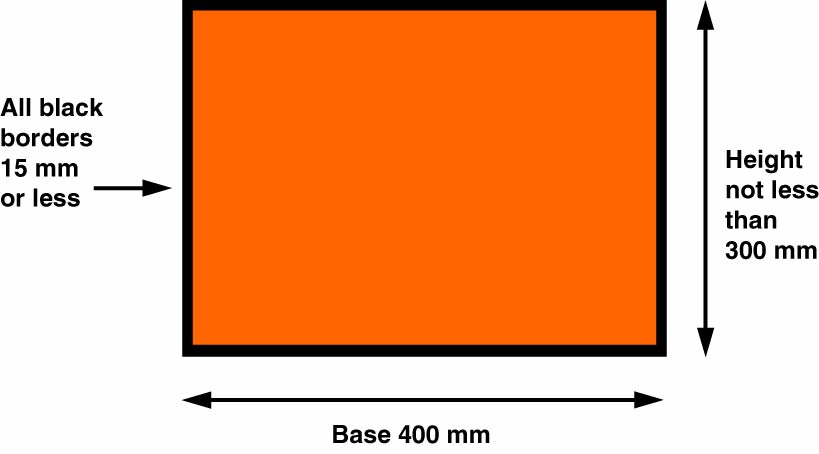
an orange-coloured panel conforming to figure 1 shall be displayed at the
front of any vehicle carrying petroleum-spirit.
4 Trailers
Paragraph 3 shall
not apply to any trailer carrying petroleum-spirit where the trailer is not
attached to a motor vehicle.
5 Carriage of petroleum-spirit in receptacles
An orange-coloured panel
conforming to figure 1 shall be displayed at the rear of any vehicle
carrying petroleum-spirit in a receptacle which is not a container or a tank.
6 Carriage of petroleum-spirit in a tank
Where a vehicle is
carrying petroleum-spirit in a tank –
(a) an
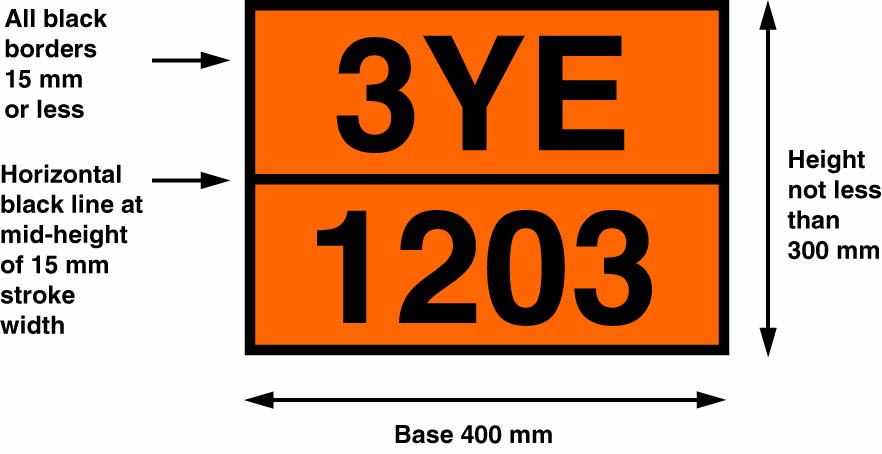
orange-coloured panel conforming to figure 2 shall be displayed at the
rear of the vehicle bearing the appropriate UN number and the appropriate
emergency action code;
(b) an
orange-coloured panel conforming to figure 2 shall be displayed on both
sides of –
(i) the tank,
(ii) the frame of the tank, or
(iii) the vehicle, provided the
panel is positioned immediately below the tank,
bearing the appropriate UN
number and the appropriate emergency action code.
7 Display of orange-coloured panels
An orange-coloured panel
required to be displayed in accordance with paragraphs 1 to 6 shall be
attached in a substantially vertical plane, and shall be –
(a) rigid
or fixed to be rigid; and
(b) in
the form of a plate.
8 Specification of display of UN numbers and emergency action
codes
A UN number or emergency
action code required to be displayed in accordance with paragraphs 1 to 6 shall
conform to the following specification –
(a) the
UN number and, subject to sub-paragraph (b), the emergency action code
shall consist of black digits, measuring not less than 100 mm in height
and not less than 15 mm stroke width;
(b) notwithstanding
subparagraph (a), where the emergency action code in column 5 of the
Approved Carriage List indicates a white letter on a black background, that
letter shall be displayed as an orange letter on a black rectangle which
rectangle shall have a height and width not less than 10 mm greater than
the height and width of the letter;
(c) subject
to paragraph 9, the UN number and the emergency action code shall be
indelible and shall remain legible after 15 minutes engulfment in fire.
9 Tanks constructed before 1st January 1999
Paragraph 8(c) shall
not apply in relation to any tank constructed before 1st January 1999.
10 Permitted variations of sizes of panels
Where the size and
construction of the vehicle are such that the available surface area is
insufficient to display orange-coloured panels conforming to the dimensions
specified in figures 1 or 2, the dimensions of the orange-coloured panels
displayed may be reduced to 300 mm at the base, 120 mm in height and with
a black border measuring 10 mm.
11 Display of the telephone number
Where a vehicle is
carrying petroleum-spirit in a tank, the telephone number shall be
displayed –
(a) at
the rear of the vehicle;
(b) on
both sides of –
(i) the tank,
(ii) the frame of the tank, or
(iii) the vehicle; and
(c) in
the immediate vicinity of the orange-coloured panels.
12 Specification of the display of the telephone number
The telephone number
shall consist of black digits of not less than 30 mm for the height and
shall be displayed on an orange-coloured background.
13 Permitted variations of the display of the telephone number
Notwithstanding paragraph 11,
the telephone number may be substituted by the text “consult local depot” or
“contact local depot” provided –
(a) the
name of the operator of the vehicle is clearly identifiable from the marking on
the tank or the vehicle;
(b) the
Chief Fire Officer has been notified in writing of the address and telephone
number of the local depot; and
(c) the
Chief Fire Officer has indicated in writing that the Chief Fire Officer is
satisfied with the arrangements.
14 Display of danger signs and subsidiary hazard signs on
containers
Where a vehicle is
carrying petroleum-spirit in a container, the danger sign specified in figure 4
shall be displayed on the container.
15 Display of danger signs on vehicles
Where a vehicle is
carrying petroleum-spirit in a tank the danger sign which is required by paragraph 13
to be displayed on a container containing petroleum-spirit shall be displayed
on each side of, and at the rear of, the vehicle.
16 Specification of display of danger signs
Subject to paragraph 17,
the danger sign required to be displayed by this Schedule shall –
(a) have
sides which measure not less than 250 mm; and
(b) have
a line of the same colour as the symbol 12.5 mm inside the edge and
running parallel to it.
17 Display of hazard warning panels
(1) Notwithstanding
paragraphs 6, 11 and 15 –
(a) the information required
to be displayed on an orange-coloured panel; and
(b) the danger sign,
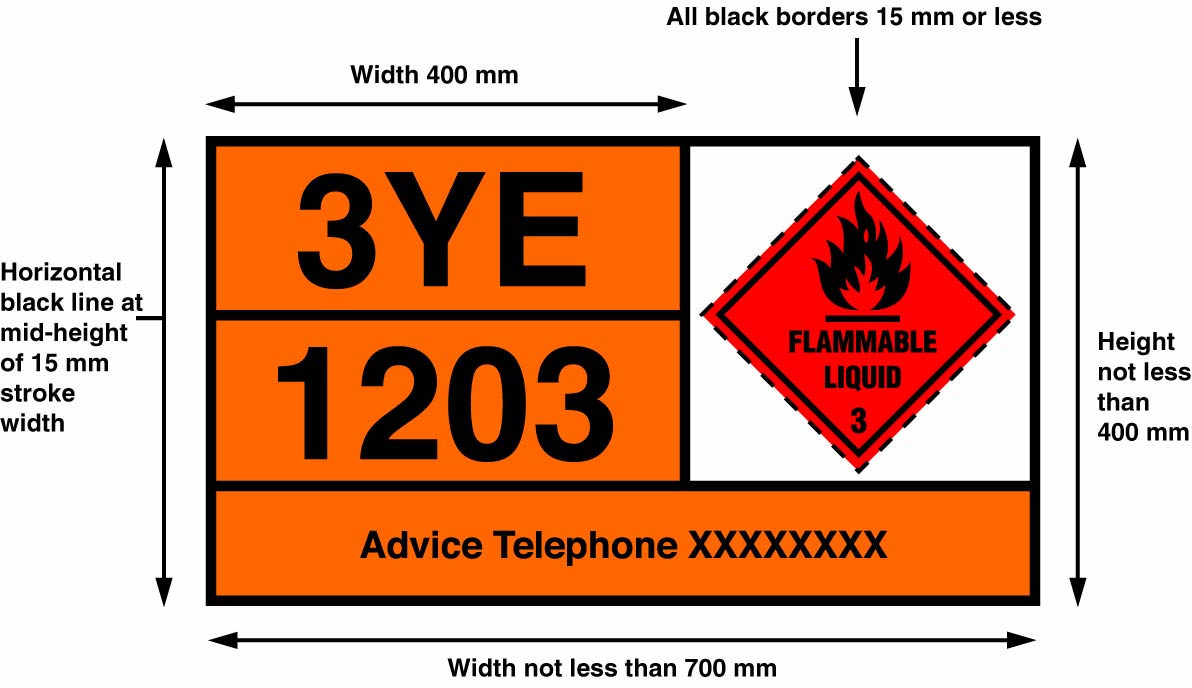
may be displayed on a
hazard warning panel, which panel shall conform to figure 3 and be
orange-coloured, except that part of it which incorporates the danger sign,
which part shall be coloured white.
(2) Notwithstanding
paragraph 16, where a hazard warning panel is displayed the danger sign
incorporated within the panel shall have –
(a) sides which measure not
less than 200 mm; and
(b) a line of the same colour
as the symbol not more than 12.5 mm inside the edge and running parallel
to it.
(3) Wherever
an orange-coloured panel conforming to figure 2 is required to be
displayed either at the rear or at the sides of a container, tank or vehicle,
the hazard warning panel may be displayed instead at the rear or at the sides,
as appropriate –
(a) on the vehicle;
(b) on a tank or container;
or
(c) on the frame of a tank or
container.
18 General
Where any orange-coloured
panel, danger sign or hazard warning panel is displayed –
(a) at
the front or at the rear of the vehicle, it shall be positioned at right angles
across the width of the vehicle; or
(b) on
the sides of a container, tank or vehicle it shall be positioned at right
angles along the length of the container, tank or vehicle concerned.
19 Visibility of signs
An orange-coloured panel,
danger sign or hazard warning panel displayed in accordance with this Schedule
shall be clearly visible.
PART 2
Figures referred to in this
Schedule
|
Figure 1
Orange-coloured panel
|
|
|
|
Figure 2
Orange-coloured panel
displaying the emergency action code and the UN number
|
|
|
|
The emergency action code shall
be inscribed in the upper half and the UN number shall be inscribed in the
lower half
|
|
Figure 3
Hazard Warning Panel
|
|
|
|
The emergency action code shall
be inscribed in the upper half and the UN number in the lower half of the
orange-coloured panel and the telephone number (or text) beneath the UN
number.
|
|
Figure 4
Danger Sign
|
|

|
|
The words under the symbol on
the sign may be omitted.
The symbol, and the words, if
included, shall be coloured either black or white.
The sign shall have a line of
the same colour as the symbol, 5 mm inside the edge of the sign and
running parallel to the edge.
|
SCHEDULE 5
(Regulation 9)
UNLOADING OF
PETROLEUM-SPIRIT AT PETROLEUM FILLING STATIONS AND CERTAIN OTHER PREMISES
LICENSED FOR THE KEEPING OF PETROLEUM-SPIRIT
PART I
General
requirements
1.
(1) It
shall be the duty of the person licensed under the Law to keep petroleum-spirit
at a particular petroleum filling station or at particular premises of the kind
specified in Regulation 9(b) (in this Schedule referred to as the
“licensee”) to ensure that the unloading of petroleum-spirit from a road tanker
at those premises (in this Schedule referred to as the “licensed premises”) is
carried out –
(a) under the person’s
control and in accordance with the procedure set out in Part 2 of this Schedule
(in this Schedule referred to as the “Part 2 procedure”); or
(b) under the control of the
driver of the road tanker making the delivery, under the authority of a licence
issued by the Minister pursuant to paragraph 19(1)(a) (a “Part 3
licence”) and in accordance with the procedure set out in Part 3 of this Schedule
(in this Schedule referred to as the “Part 3 procedure”); and
(c) in either case –
(i) subject to the provisions of this Part of
this Schedule, and
(ii) by transferring the
petroleum-spirit from the tank of the road tanker into a storage tank.
(2) Where
the licensee has been granted a Part 3 licence in respect of the licensed
premises, the licensee shall only use the Part 3 procedure at those
premises unless –
(a) the licensee has given at
least one week’s notice to the Chief Fire Officer that the licensee intends to
change to using the Part 2 procedure and that notice period has expired;
or
(b) due to failure of
equipment, compliance with the Part 3 procedure has ceased to be possible
and the licensee has agreed with the operator and (where the operator is not
the supplier of the petrol) with the supplier to revert temporarily to the Part 2
procedure pending correction of the equipment.
(3) Where
the temporary use of the Part 2 Procedure occurs in accordance with sub-paragraph (2)(b),
the licensee shall give notice to the Chief Fire Officer –
(a) of the licensee having
commenced such temporary use; and
(b) of the licensee having
resumed the use of the Part 3 procedure upon correction of the equipment
failure.
(4) Any
notice required to be given in accordance with sub-paragraph (3) shall be
given by the quickest practicable means.
(5) The
licensee shall, within 3 working days of giving any notice in accordance
with sub-paragraph (3), give written confirmation of that notice to the
Chief Fire Officer.
(6) In
sub-paragraph (5), the reference to “3 working days” is a reference
to a period of 72 hours calculated from the time the relevant notice was
given in accordance with sub-paragraph (3), but disregarding so much of
any such period as falls on a Saturday or Sunday, or on Christmas day or Good
Friday, or a day which has been appointed a public holiday or a bank holiday
under the Public
Holidays and Bank Holidays (Jersey) Law 1951.
2.
(1) The
licensee shall, for the purpose of distinguishing one storage tank from any
other storage tank situated at the licensed premises, ensure that every such
tank is clearly marked with –
(a) a number, a letter or a
combination of both a number and a letter in such a manner that the number,
letter or number and letter cannot be readily altered or obliterated; and
(b) adjacent to that number,
letter or number and letter, the maximum working capacity of the tank and the
grade of petroleum-spirit permitted to be stored therein under the licence
granted in respect of the licensed premises.
(2) In
this Schedule, a reference to the maximum working capacity of a storage tank
shall be a reference to 97% of its actual capacity, expressed in litres.
3. For
the purpose of distinguishing one compartment of the tank of a road tanker from
each other compartment of that tank, the operator shall ensure that every such
compartment is clearly marked with a number in such a manner that that number
cannot readily be altered or obliterated.
4. The
licensee shall ensure that every dipstick, not being one permanently fixed to a
storage tank, and any other device used for ascertaining the quantity of the
petroleum-spirit for the time being contained in a storage tank, is marked with
the same number, letter or combination of both a number and letter and in the
same manner as that with which the storage tank in connection with which it is
used is marked.
5. Where
the method of filling a storage tank is by means of a pipe (whether in a single
length or segmented) leading from the tank to a filling point not situated on,
or immediately adjacent to, the tank itself, the licensee shall ensure that the
pipe is clearly marked on, or immediately adjacent to, the filling point
with –
(a) the same number, letter
or combination of both a number and letter and in the same manner as that with
which the tank is marked; and
(b) adjacent to that number,
letter or number and letter, the maximum working capacity of the tank and the
grade of petroleum-spirit permitted to be stored in it under the licence
granted in respect of the licensed premises.
6. In
any case where the method of filling the tank is that referred to in paragraph 5,
the licensee shall ensure, so far as practicable, that no filling takes place
until –
(a) the pipe is properly and
securely connected to the tank and to the filling point; and
(b) (where the pipe is
segmented) each segment is properly and securely connected one with another.
7. Where,
during the course of filling a storage tank, vapours given off by that storage
tank are returned to the road tanker by means of a vapour balance pipe which is
connected to a vapour balance hose emanating from that road tanker, the
licensee shall ensure that that vapour balance pipe is marked with the words
“vapour balance”.
8.
(1) The
licensee shall appoint a competent person over the age of 18 years
(in this Schedule referred to as the “competent person”) who shall be permitted
neither to be the driver of, nor to be employed to be in attendance on, any
vehicle from which a delivery of petroleum-spirit is to be made at the licensed
premises and who shall have the functions given to the competent person by Parts 2
and 3 of this Schedule.
(2) The
licensee shall ensure that –
(a) the competent person has
received adequate training to enable the competent person to understand –
(i) the nature of the dangers to which the
carriage of petroleum-spirit may give rise, and
(ii) the functions given to the
competent person by Parts 2 and 3 of this Schedule and the competent person’s
duties under Articles 4 and 8 of the Health and Safety at Work
(Jersey) Law 1989; and
(b) a record of the training
received pursuant to sub-paragraph (2)(a) is available at the licensed
premises.
PART 2
THE PART 2 PROCEDURE
Procedure
for licensee-controlled deliveries
9. The
competent person shall be in charge of the storage tank for the purpose of the
delivery and shall not permit delivery into that tank to commence –
(a) unless the tank has
immediately before the delivery been measured with a dipstick or other suitable
measuring device and the measurement has shown that the quantity of
petroleum-spirit proposed to be delivered can safely be received by that tank;
and
(b) until –
(i) the hose (whether a single length or
segmented) through which the petroleum-spirit will be delivered (the “delivery
hose”) is connected to the filling point of that tank, and
(ii) (where the provisions of
paragraph 7 apply to the delivery) the vapour balance hose is secured to
the vapour balance pipe before the delivery hose is connected;
(c) (in any case where there
is a separate dipping opening in the storage tank) until that dipping opening
has been securely closed; and
(d) where siphon pipes link
storage tanks at the licensed premises and none of the linked tanks is fitted
with a mechanical overfill prevention device, until the tank has been isolated
from the other storage tanks by the closure of suitable valves,
and shall not as respects
that tank sign the competent person’s name on the certificate referred to in paragraph 10
until the competent person has complied with the appropriate requirements of
clauses (a) to (d).
10. Before
delivery into any storage tank is begun, the competent person shall, in the
presence of the driver of the road tanker from which the delivery is to be
made, in Part A of each of 2 copies of a certificate in the form specified
in Part 4 of this Schedule –
(a) in the first column,
enter the address of the licensed premises concerned;
(b) in the second column,
enter the name of the licensee of the premises;
(c) in the third column,
enter the number, letter or number and letter marked on the tank;
(d) in the fourth and fifth
columns, enter the quantity and grade respectively of petroleum-spirit which is
to be delivered into the tank;
(e) in the sixth column,
enter his or her signature; and
(f) in the seventh column
enter the correct date and time.
11. The
driver of a road tanker shall not commence any delivery of petroleum-spirit
into a storage tank until –
(a) the driver has, after the
competent person has completed Part A of each of 2 copies of a certificate
in the form specified in Part 4 of this Schedule in accordance with paragraph 10,
in Part B of each of the 2 copies –
(i) in the first column, entered the number,
letter or number and letter marked on the tank,
(ii) in the second column,
entered the number of each compartment of any tank of a road tanker from which
the petroleum-spirit is to be delivered, and
(iii) in the third column,
entered the competent person’s signature;
(b) the driver has –
(i) properly and securely connected the
delivery hose (whether a single length or segmented) to –
(A) the appropriate outlet on
the road tanker, and
(B) the filling point of the
tank, and
(ii) where the delivery hose
is segmented, properly and securely connected each segment one with another;
(c) where the provisions of paragraph 7
apply to the delivery, the driver has, before properly and securely connecting
the delivery hose and, where appropriate, any of its segments, properly and
securely connected the vapour balance hose –
(i) to the vapour balance pipe, and
(ii) to the appropriate
faucet on the road tanker; and
(d) the competent person is
keeping watch as required by paragraph 12.
12. The
competent person shall, during the whole time of a delivery of petroleum-spirit
into a storage tank, be in close proximity to the road tanker and the storage
tank and shall, so far as is practicable, keep a constant watch on the licensed
premises for the purpose of preventing any hazardous situation arising.
13. The
driver of a road tanker shall ensure that, during the whole time of a delivery
of petroleum-spirit from the tanker –
(a) except where the engine
has to be used to drive the pumps or other appliances for loading or unloading
the vehicle, neither its engine, nor any other engine or motor which is
attached to the road tanker, is run; and
(b) the road tanker remains
stationary.
14. During
the whole time of a delivery of petroleum-spirit from a road tanker, the driver
of the tanker shall remain near it, and shall –
(a) so far as is practicable,
keep a constant watch on –
(i) the delivery hose (whether a single length
or segmented), the connections at both ends of the delivery hose and, in the
case of a segmented hose, each connection between the segments,
(ii) where the provisions of paragraph 7
apply to the delivery, the vapour balance hose and the connections at both ends
of that hose, and
(iii) the tank of the road
tanker; and
(b) ensure, so far as is
practicable, that no petroleum-spirit escapes from any hose connection such as
is specified in clause (a)(i).
15. Both
the driver and the competent person shall, during the whole time of a delivery
of petroleum-spirit from a road tanker into a storage tank, ensure, so far as
is practicable, that no petroleum-spirit overflows from the storage tank
concerned.
16. The
driver of a road tanker shall ensure that petroleum-spirit from a single
compartment of the tank of the road tanker is not delivered into more than one
storage tank unless –
(a) each of the storage tanks
into which the petroleum-spirit is to be delivered can safely receive all of
the petroleum-spirit remaining in the compartment;
(b) either the foot valve or
the faucet valve for the compartment can be operated from on top of the tank of
the road tanker and dipping of the compartment is carried out on a continual
basis; or
(c) other effective and
reliable mechanical or other measures are taken to prevent overfilling of each
of the storage tanks concerned.
17. When
the driver of a road tanker has completed a delivery of petroleum-spirit to
which the provisions of paragraph 7 applied, the driver shall disconnect
the vapour balance hose having first disconnected the delivery hose.
18. The
competent person shall, following the completion of a delivery of
petroleum-spirit from a road tanker –
(a) give one of the 2 copies
of the certificate completed in accordance with paragraphs 10 and 11 to
the driver of the road tanker from which the delivery has been made, and the
driver shall give it to the supplier of the petroleum spirit, who shall keep it
for a period of not less than 12 months after the delivery; and
(b) give the second of the
2 copies of the certificate completed in accordance with paragraphs 10
and 11 to the licensee of the premises where the delivery was made, who shall
keep it at those premises for a period of not less than 12 months after
the delivery.
PART 3
THE PART 3 PROCEDURE
Procedure for driver-controlled deliveries
19.
(1) A
licensee shall not use the Part 3 procedure at the licensee’s licensed
premises unless –
(a) the licensee has made
application in writing to the Minister and has received from him or her a Part 3
licence –
(i) in the form specified in Part 4 of
this Schedule, and
(ii) which has been completed
in accordance with the Note to that Part; and
(b) the licensee has agreed
in writing with –
(i) the operator of each road tanker which is
likely to deliver petroleum-spirit to the licensed premises, and
(ii) each person (not being
any such operator as is specified above) who is likely to supply
petroleum-spirit to the licensed premises,
that (subject to the
occurrence of either of the events specified in paragraph 1(2)) that
procedure is to be followed for all future deliveries.
(2) When
the Minister receives an application made in accordance with paragraph (1)(a),
he or she shall not refuse to grant a Part 3 licence except on grounds
relating to the safety of the specific site in respect of which the licence
application has been made and, having granted such a licence, the Minister may
subsequently revoke it in writing at any time.
(3) A
fee of £50.00 shall be payable by the applicant to the Minister on each
application for a Part 3 licence made in accordance with sub-paragraph (1)(a).
20.
(1) Where
the licensee intends to use the Part 3 procedure at the licensed premises,
the licensee shall ensure that –
(a) the cap on the filling
point of each storage tank is locked with a captive padlock, the key of which
shall –
(i) be identified with the number, letter or
number and letter corresponding with the number, letter or number and letter
marked on the relevant storage tank, and
(ii) have a different profile
from the key used for any other such padlock;
(b) a suitable measuring
device is provided for each storage tank which device shall –
(i) be capable of continuously and visually
indicating the ullage in that tank,
(ii) be clearly marked
(adjacent to the said visual indication of ullage) with the number, letter or
number and letter marked on that tank, and
(iii) in the event of failure,
indicate that the tank is full or that there is a fault condition;
(c) a ticket printer is
provided which is capable of issuing a ticket on which the following
information is indicated –
(i) the date and time of each delivery, and
(ii) (in respect of each
storage tank) the number, letter or number and letter marked on the tank, the
grade of petroleum-spirit permitted to be stored therein under the licence
granted in respect of the licensed premises and the ullage of the tank;
(d) a suitable high-level
alarm which is audible to the driver is provided for each storage tank; and,
where the measuring device referred to in sub-paragraph (1)(b) operates on
the principle of differential air pressure, the licensee shall also ensure that
the system by which that operation is effected will fail safe in the event of a
failure of the air supply, and thereby sound the audible high level alarm;
(e) safe and adequate
illumination having an illuminance of 100 lux or more measured at ground
level is provided for any area in which the vehicle stands during unloading and
any area in which a storage tank filling point or a measuring device referred
to in sub-paragraph (1)(b) is situated, together with means which are
accessible to the driver for switching the illumination on or off;
(f) one or more telephones
are provided which are accessible to the driver and which will enable the
driver to make direct contact with the emergency services and with the depot
from which the licensee operates;
(g) a fire extinguisher
suitable for fighting petroleum-spirit fires is provided which is accessible to
the driver and has a minimum test fire rating of 144B, as defined in British
Standard BS EN3-1: 1996;
(h) at least 25 kg of
dry sand or such quantity of other suitable absorbent material as gives an equivalent
degree of absorbency is, in conjunction with suitable tools for applying it,
provided in a suitable container, for the purpose of containing spillages;
(i) a plan of the licensed
premises is provided, which –
(i) shall have been approved by the Chief Fire
Officer,
(ii) is accessible to the
driver,
(iii) indicates the position of
each filling point, together with its number or identifying letter, the
capacity of the tank to which it is connected and the grade of petroleum-spirit
which the tank is permitted to contain under the licence, and
(iv) indicates the unloading
position for the vehicle and the position of the surface drainage points; and
(j) a switch, which is
capable of cutting off the power supply to all the petroleum-spirit, diesel
and, where appropriate, liquefied petroleum gas pumps at the licensed premises
is provided adjacent to each telephone provided pursuant to clause (f).
(2) The
licensee shall ensure that the operator of any road tanker which is likely to
make deliveries of petroleum-spirit to the licensed premises is given written
notice of any conditions which apply to such deliveries and which are attached
to the licence granted in respect of those premises.
(3) In
this Schedule, “ullage” means the difference (expressed in litres) between the
maximum working capacity of a storage tank and the quantity of petroleum-spirit
in it at any given time.
21. The
licensee or the competent person shall, before the commencement of a delivery
of petroleum-spirit into a storage tank at the licensed premises –
(a) In Part A of each of
2 copies of a certificate in the form specified in Part 5 of this Schedule –
(i) in the first column, enter the address of
the licensed premises,
(ii) in the second column,
enter the name of the licensee,
(iii) in the third column,
enter the number, letter or number and letter marked on the tank,
(iv) in the fourth and fifth
columns, enter the quantity and grade respectively of petroleum-spirit which is
to be delivered into the tank,
(v) in the sixth column, enter the licensee or
competent person’s signature, having first visually checked that the ullage in
the tank as indicated by the tank measuring device provided in accordance with paragraph 20(1)(b)
exceeds the quantity of petroleum-spirit to be received by that tank, and
(vi) in the seventh column,
enter the correct date and time; and
(b) having completed Part A
of each of 2 copies of a certificate in the form specified in Part 5 of
this Schedule in the manner specified in clause (a), ensure that both
those copies are given to the driver who is to make the delivery.
22. Before
making any delivery of petroleum-spirit by the Part 3 procedure, the
operator shall ensure that –
(a) each compartment of the
tank of the road tanker which is to make the delivery is fitted with a
bottom-operated foot-valve;
(b) means are provided to
shut off all valves referred to in clause (a) in an emergency;
(c) the road tanker is loaded
in such a way that the contents of a single compartment of its tank will not
need to be split between 2 storage tanks when the petroleum-spirit is unloaded;
and
(d) the driver of the road
tanker is given a written copy of any conditions of which the operator has been
given notice under paragraph 20(2).
23. A
driver of a road tanker who makes a delivery of petroleum-spirit in accordance
with the Part 3 procedure shall –
(a) comply with any
conditions given to the driver in accordance with paragraph 22(d);
(b) immediately before
commencing the delivery –
(i) in Part B of each of the 2 copies of
the certificate required to be given to the driver in accordance with paragraph 21(b) –
(A) in the first column, enter
the number, letter or number and letter marked on the storage tank into which
delivery is to be made,
(B) in the second column,
enter the number of each compartment of any tank of the road tanker from which
the petroleum-spirit is to be delivered, and
(C) in the third column, enter
the driver’s signature,
(ii) verify the availability
of the key of the captive padlock with which, in accordance with paragraph 20(1)(a),
the cap on the filling point of each storage tank which is specified in the
copies of the certificate required to be given to the driver in accordance with
paragraph 21(b) must be locked,
(iii) verify that the quantity
to be delivered may be safely received by the storage tank by visually checking
that the ullage indicated on a ticket obtained from the ticket printer provided
in accordance with paragraph 20(1)(c) exceeds the quantity to be delivered
into that tank,
(iv) verify that there is a
dialling tone on each telephone provided in accordance with paragraph 20(1)(f),
(v) place the fire extinguisher provided in
accordance with paragraph 20(1)(g) and the sand or other absorbent
material and tools provided in accordance with paragraph 20(1)(h) in a
convenient position close to the road tanker unloading point,
(vi) test the high level alarm
provided in accordance with paragraph 20(1)(d) to verify that the audible
signal functions correctly, and
(vii) take all reasonable steps
to ensure that –
(A) the delivery hose, whether
a single length or segmented, is properly and securely connected to the
appropriate outlet on the road tanker and to the filling point of the storage
tank,
(B) where the delivery hose
is segmented, each segment is properly and securely connected one with another,
and
(C) where the provisions of paragraph
7 apply to the delivery, the vapour balance hose is properly and securely
connected to the vapour balance pipe and to the appropriate outlet on the road
tanker before the delivery hose and, where appropriate, any segments of the
hose are properly and securely connected;
(c) during the whole time of
delivery –
(i) except where the engine has to be used to
drive the pumps or other appliances for loading or unloading the vehicle,
ensure that the engine of the road tanker and any other engine or motor which
is attached to it is not run,
(ii) ensure that the road
tanker remains stationary,
(iii) ensure, so far as is
practicable, that no petroleum-spirit –
(A) overflows from the storage
tank concerned, or
(B) escapes from any hose
connection such as is specified in clause (b)(vii)(A) and (B), and
(iv) so far as practicable,
keep a constant watch on the filling point of the storage tank, the tank of the
road tanker, the delivery hose, whether a single length or segmented, and,
where the provisions of paragraph 7 apply to the delivery, the vapour
balance hose and the connections at both ends of that hose; and
(d) after the delivery is
complete but before departing from the relevant premises –
(i) ensure that all caps on the filling points
into which deliveries have been made are securely closed and locked,
(ii) (where the provisions of
paragraph 7 applied to the delivery, but having first disconnected the
delivery hose, whether a single length or segmented) disconnect the vapour
balance hose, and
(iii) ensure that all manhole
covers which were disturbed during this delivery have been securely replaced.
24. The
driver of a road tanker which has completed a delivery of petroleum-spirit in
accordance with the Part 3 procedure shall –
(a) ensure that one of the 2
duly completed copies of the certificate given to the driver in accordance with
paragraph 21(b) and completed by the driver in accordance with paragraph 23(b)(i))
before the delivery commenced is given back to the licensee, who shall keep it
at the licensed premises for a period of at least 12 months; and
(b) give the other copy of
the certificate referred to in clause (a) to the supplier of the
petroleum-spirit.
25. The
supplier of the petroleum-spirit shall keep the copy certificate that the
supplier has been given in accordance with paragraph 24(b) for at least
12 months from the date of the relevant delivery.
PART 4
FORM OF CERTIFICATE FOR
LICENSEE-CONTROLLED DELIVERIES
The Petroleum-spirit (Carriage
by Road) (Jersey) Regulations 2001 (“the Regulations”)
Licensee-controlled deliveries in
accordance with Part 2 of Schedule 5 to the Regulations
PART A
|
First Column
|
Second Column
|
|
Address of licensed
premises
|
Name of licensee
|
|
|
|
|
|
|
|
|
|
|
Third Column
|
Fourth Column
|
Fifth Column
|
Sixth Column
|
Seventh Column
|
|
Storage tank number, letter or number and letter
|
Quantity of petrol to be delivered
|
Grade of petrol to be delivered
|
Signature of competent person (to
certify that he or she has complied with the appropriate requirements of paragraph 9(a) to (d) of Schedule 5 to the Regulations
before delivery commences)
|
Date and time of completion of this Part
of the Certificate
|
|
|
|
|
|
|
|
|
|
|
|
|
|
|
|
|
|
|
|
|
|
|
|
|
|
|
|
|
|
|
|
|
|
|
|
|
|
|
|
|
|
|
Note: In Part A, the
competent person appointed by the licensee must enter –
(a) in the first column, the
address of the licensed premises concerned;
(b) in the second column, the
name of the licensee;
(c) in the third column the
relevant storage tank number, letter or number and letter;
(d) in the fourth and fifth
columns, the quantity and grade respectively of petroleum-spirit to be
delivered;
(e) in the sixth column, the
competent person’s signature; and
(f) in the seventh column,
the correct date and time.
This Part must be completed before
delivery into the tank commences. The sixth column may only be completed after
compliance with the appropriate clauses of paragraph 9 of Schedule 5 to
the Regulations.
Paragraph 9 reads as
follows –
“9. The
competent person shall be in charge of the storage tank for the purpose of the
delivery and shall not permit delivery into that tank to commence –
(a) unless the tank has
immediately before the delivery been measured with a dipstick or other suitable
measuring device and the measurement has shown that the quantity of
petroleum-spirit proposed to be delivered can safely be received by that tank;
and
(b) until –
(i) the hose (whether a single length or
segmented) through which the petroleum-spirit will be delivered (the “delivery
hose”) is connected to the filling point of that tank, and
(ii) (where the provisions of
paragraph 7 apply to the delivery) the vapour balance hose is secured to
the vapour balance pipe before the delivery hose is connected;
(c) (in any case where there
is a separate dipping opening in the storage tank) until that dipping opening
has been securely closed; and
(d) where siphon pipes link
storage tanks at the licensed premises and none of the linked tanks is fitted
with a mechanical overfill prevention device, until the tank has been isolated
from the other storage tanks by the closure of suitable valves,
and shall not as respects
that tank sign his or her name on the certificate referred to in paragraph 10
until he or she has complied with the appropriate requirements of clauses (a)
to (d).”
PART B
|
First Column
|
Second Column
|
Third Column
|
|
Storage tank number, letter
or number and letter
|
Road tanker carrying tank
compartment numbers
|
Signature of driver
|
|
|
|
|
|
|
|
|
|
|
|
|
|
|
|
|
|
|
|
|
|
|
|
|
|
|
|
|
|
|
|
|
Note: In Part B, the driver must
enter –
(a) in the first column, the
relevant storage tank number, letter or number and letter;
(b) in, the second column,
the number of each compartment of any carrying tank from which the
petroleum-spirit is to be delivered; and
(c) in the third column, the
driver’s signature.
This Part must be completed after Part
A has been completed by a competent person appointed by the licensee, but
before delivery into the tank commences.
PART 5
FORM OF CERTIFICATE FOR
DRIVER-CONTROLLED DELIVERIES
The Petroleum-spirit (Carriage by Road) (Jersey)
Regulations 2001 (“the Regulations”)
Driver-controlled deliveries in
accordance with Part 3 of Schedule 5 to the Regulations
PART A
|
First Column
|
Second Column
|
|
Address of licensed
premises
|
Name of licensee
|
|
|
|
|
|
|
|
|
|
|
Third Column
|
Fourth Column
|
Fifth Column
|
Sixth Column
|
Seventh Column
|
|
Storage tank number, letter or number and letter
|
Quantity of petrol to be delivered
|
Grade of petrol to be delivered
|
Signature of licensee or competent person
(to certify that in accordance with paragraph 21(a)
of Schedule 5 to the Regulations he or she has visually checked the
ullage space in the storage tank)
|
Date and time of completion of this Part
of the Certificate
|
|
|
|
|
|
|
|
|
|
|
|
|
|
|
|
|
|
|
|
|
|
|
|
|
|
|
|
|
|
|
|
|
|
|
|
|
|
|
|
|
|
|
|
|
|
|
|
|
Note: In this Part, the licensee
or some other competent person acting on the licensee’s behalf must
enter –
(a) in the first column, the
address of the licensed premises concerned;
(b) in the second column, the
licensee’s name;
(c) in the third column, the
relevant storage tank number, letter or number and letter;
(d) in the fourth and fifth
columns, the quantity and grade respectively of petroleum-spirit to be
delivered;
(e) in the sixth column, the
licensee or competent person’s signature; and
(f) in the seventh column,
the correct date and time.
This Part must be completed before
delivery into the tank commences. The sixth column may only be completed after
the person concerned has measured the ullage space in the tank.
PART B
|
First
Column
|
Second
Column
|
Third
Column
|
|
Storage
tank number, letter or number and letter
|
Road
tanker carrying tank compartment numbers
|
Signature
of driver
|
|
|
|
|
|
|
|
|
|
|
|
|
|
|
|
|
|
|
|
|
|
|
|
|
|
|
|
|
|
|
|
|
|
|
|
|
|
|
|
|
Note: In this Part, the driver
must enter –
(a) in the first column, the
relevant storage tank number, letter or number and letter;
(b) in the second column, the
number of each compartment of any carrying tank from which the petroleum-spirit
is to be delivered; and
(c) in the third column, the
driver’s signature.
This Part must be completed after Part A
has been completed by the licensee or by a competent person acting on the
licensee’s behalf, but before delivery into the tank commences.
PART 6
FORM OF PART 3 LICENCE
Part 3 licence
The Petroleum-spirit (Carriage
by Road) (Jersey) Regulations 2001 (“the Regulations”)
Driver-controlled deliveries in
accordance with Part 3 of Schedule 5 to the Regulations
|
First Column
|
Second Column
|
Third Column
|
Fourth Column
|
|
Address of licensed
premises
|
Name of licensee
|
Signature of person issuing licence on behalf of the Home
Affairs Committee
|
Date of issue of Part 3 licence
|
|
|
|
|
|
Note: A person duly
authorized by the Minister for Home Affairs to act in the following behalf
shall enter –
(a) in
the first column, the address of the premises to which the Part 3 licence
applies;
(b) in
the second column, the name of the licensee of those premises;
(c) in
the third column, the person duly authorized’s signature; and
(d) in
the fourth column, the date on which the Part 3 licence is issued.