Social Security
(Medical Certification) (Jersey) Order 1974
THE EMPLOYMENT
AND SOCIAL SECURITY COMMITTEE, in pursuance of 29 of the Social Security (Jersey) Law 1974,[1] orders as follows –
Commencement [see endnotes]
1 Interpretation
(1) In
this Order, unless the context otherwise requires –
“determining authority” means, as the case
may require, the determining officer or the Social Security Tribunal;
“incapacity” means incapacity by reason of
which a person is rendered incapable of work;
“Law” means the Social Security (Jersey) Law 1974;[2]
“signature” means, in relation to any
certificate, the name by which the person giving the certificate is usually
known (any name other than the surname being either in full or otherwise
indicated) written by that person in the person’s own handwriting; and
the expression “signed” shall
be construed accordingly.
(2) For
the purpose of any provision of this Order providing that any certificate shall
be in a form set out in Schedule 1 or 2, any reference to such form shall
include a reference to any such other form substantially to the like effect as
the Committee may from time to time approve.
2 Evidence of incapacity and
confinement[3]
(1) Every
person claiming short term incapacity allowance shall furnish evidence of
incapacity, in respect of the day or days for which the claim is made –
(a) in the form set out in Part B of Schedule 1;
or
(b) by such other means as the determining
authority may accept as sufficient in the circumstances of any particular case
or class of cases.
(2) Where
the evidence is in the form set out in Part B of Schedule 1, the certificate in
that form (as defined in paragraph 1 of Part A of that Schedule) shall be
completed in accordance with Part A of that Schedule.
(3) Every
woman by whom or on whose behalf a claim for maternity benefit is made shall
furnish evidence –
(a) where the claim is made in respect of
expectation of confinement, that she is pregnant and as to the stage which she
has reached in her pregnancy; or
(b) where the claim is made by virtue of the
fact of confinement, that she has been confined.
(4) The
evidence to which paragraph (3) refers shall be furnished –
(a) in the form set out in Part B of Schedule 2;
or
(b) by such other means as the determining
authority may accept as sufficient in the circumstances of any particular case
or class of cases.
(5) Where
the evidence is in the form set out in Part B of Schedule 2, the certificate in
that form shall be completed in accordance with Part A of that Schedule.
3 Citation
This Order may be cited as the
Social Security (Medical Certification) (Jersey) Order 1974.
SCHEDULE 1
(Article 2(1))
INCAPACITY
PART A
RULES FOR MEDICAL
CERTIFICATION
1. In
these rules, unless the context otherwise requires –
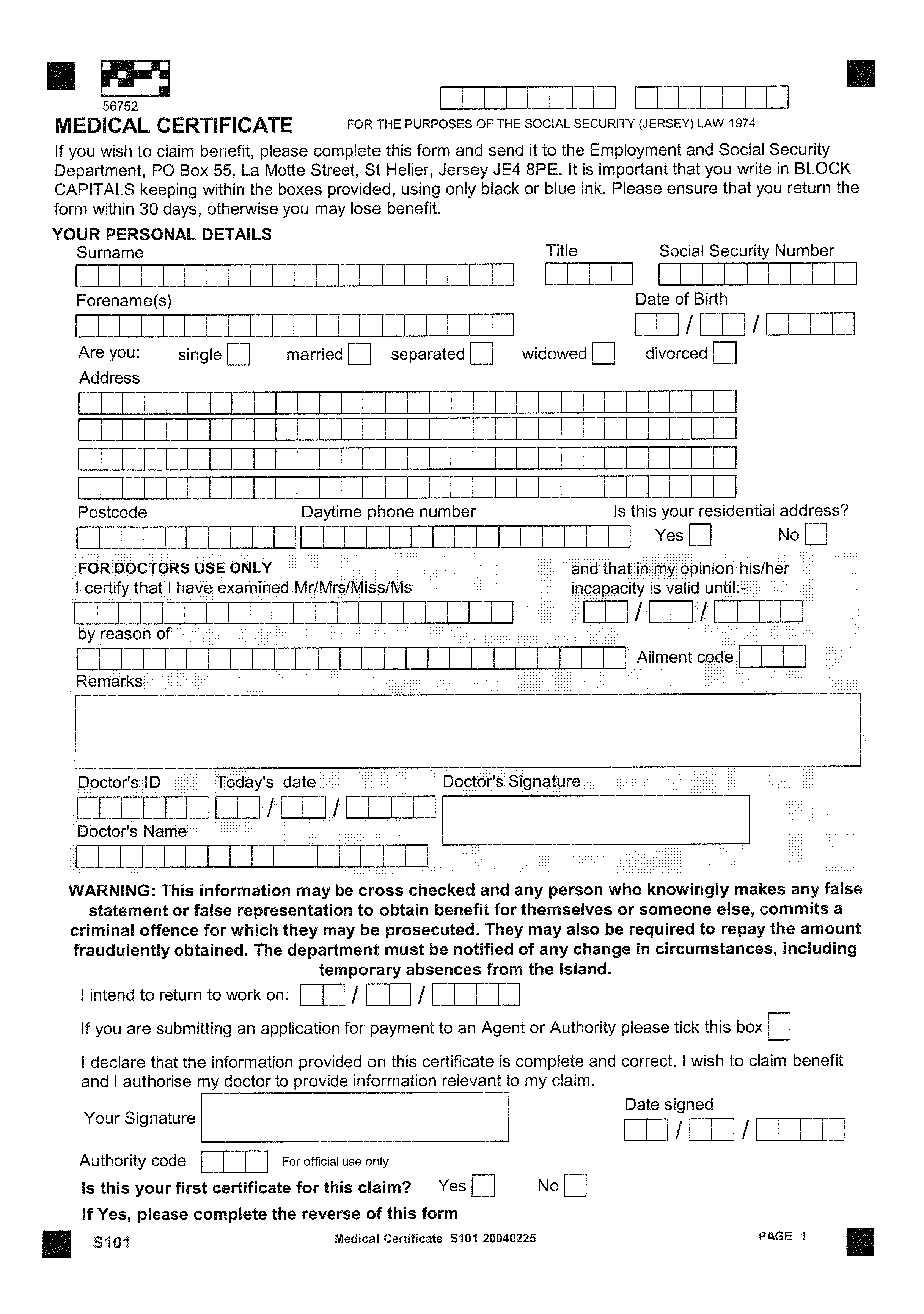
“certificate” means
that part of the form in Part B of this Schedule that is headed “FOR
DOCTORS USE ONLY”;[4]
“claimant” means the person
in respect of whom a certificate is given;
“practitioner” means
a medical practitioner not being the claimant.
2. Every
certificate shall be in writing in ink or other indelible substance, and shall
contain the following particulars –
(a) the claimant’s name;
(b) [5]
(c) a concise statement of the disease,
disablement or injury by which the claimant is, in the practitioner’s
opinion, at the time rendered incapable of work;
(d) the date on which the certificate is given,
and shall bear, under the words
“Doctor’s signature”, the signature of the certifying
practitioner written after there have been entered on the certificate the
claimant’s name and a statement of the disease, disablement or injury.[6]
3. The
statement of the incapacitating disease, disablement or injury in the
certificate shall specify the cause of incapacity as precisely as the
practitioner’s knowledge of the claimant’s condition at the time of
the examination permits:
Provided that, if in the
practitioner’s opinion a disclosure to the claimant of the precise cause
would be prejudicial to the claimant’s well-being, the certificate may
contain a less precise statement.
4. Every
certificate must have been given on a date not more than one day later than the
date of the examination on which it is based, and no further certificate based
on the same examination shall be furnished other than a certificate to replace
an original certificate which has been lost or mislaid, but in that case the
form shall be clearly marked “duplicate”.
5. In
any case in which, in the opinion of the practitioner, the claimant will become
fit to resume work on a day not later than the end of the seventh day after the
date of examination on which the certificate is based, the certificate shall
specify the first-mentioned day.
6. In
any other case, the certificate shall cover a specified number of days or weeks
from and including the date of the examination on which the certificate is
based, which period shall not exceed 28 days or, where at that date the
certificate of incapacity has continued for not less than 28 days, 13 weeks.
7. Before
resuming work, every claimant shall furnish a certificate in accordance with
the provisions of rule 5 of these rules specifying the date on which, in the
opinion of the practitioner, the claimant will become fit to resume work.
8. In
computing any period of time in relation to any certificate given under rule 5
or 6 of these rules, Sunday shall not be disregarded.
PART
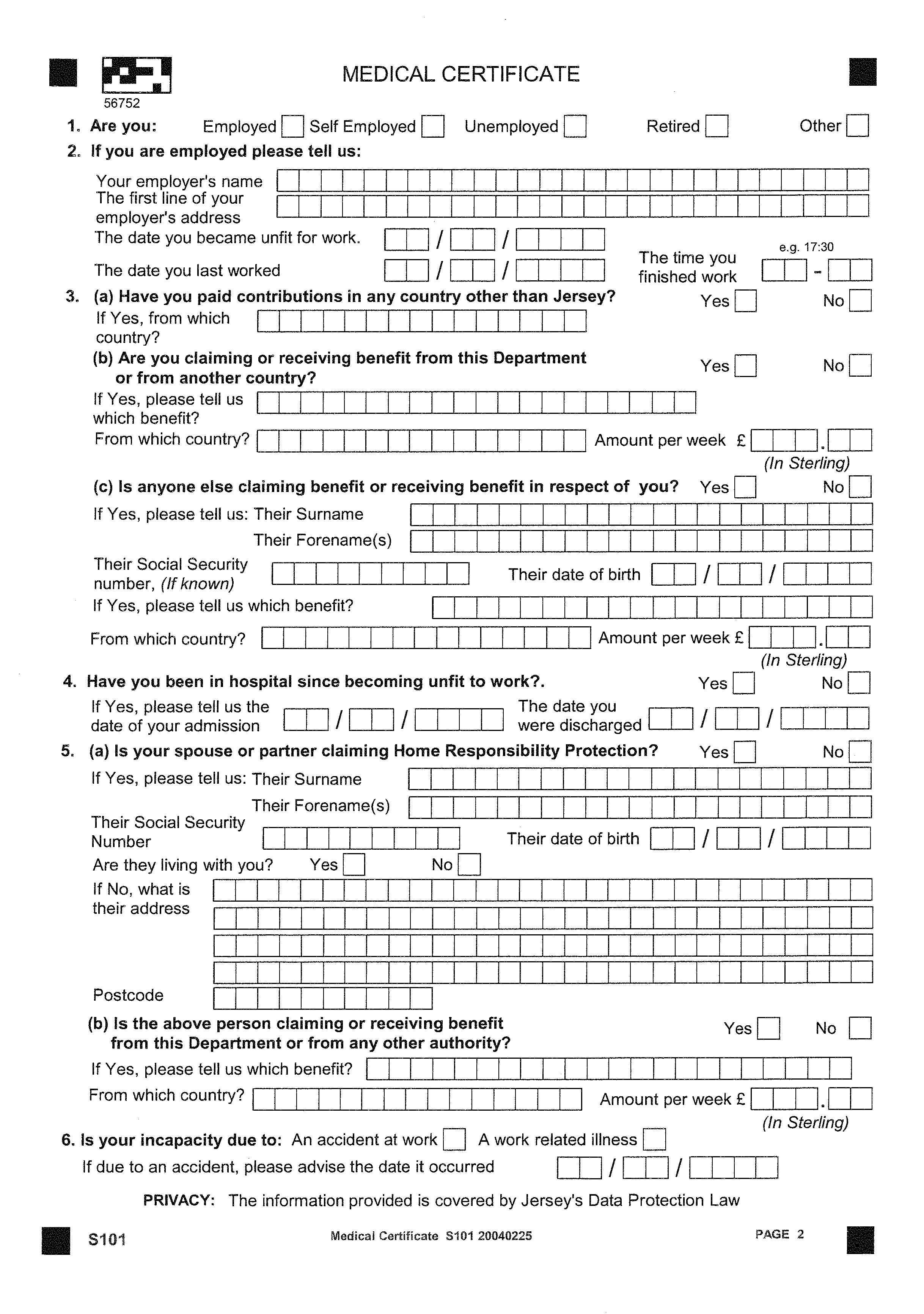
B[7]
EVIDENCE
OF INCAPACITY
SCHEDULE 2
(Article 2(2))
CONFINEMENT
PART A
RULES FOR CERTIFICATION
1. In
these rules “midwife” means a person authorized to exercise the
profession of midwife in Jersey under the Loi
(1922) sur la Santé Publique (Sages-femmes).[8]
2. Certificates
of confinement or expected confinement shall be in writing in ink or other
indelible substance signed by the medical practitioner or midwife attending the
woman.
3. Every
certificate of confinement or expected confinement shall contain the following
particulars –
(a) the woman’s name;
(b) as appropriate, the actual date of
confinement or the week in which it is to be expected that the woman will be
confined, and in either case the date of the examination on which the
certificate is based; and
(c) the date on which the certificate is given,
and the certificate shall be
adjusted and completed accordingly.[9]
4. After
a certificate based on an examination has been given, no further certificate
based on the same examination shall be furnished other than a certificate to
replace an original certificate which has been lost or mislaid, but in that
case the form shall be clearly marked “duplicate”.
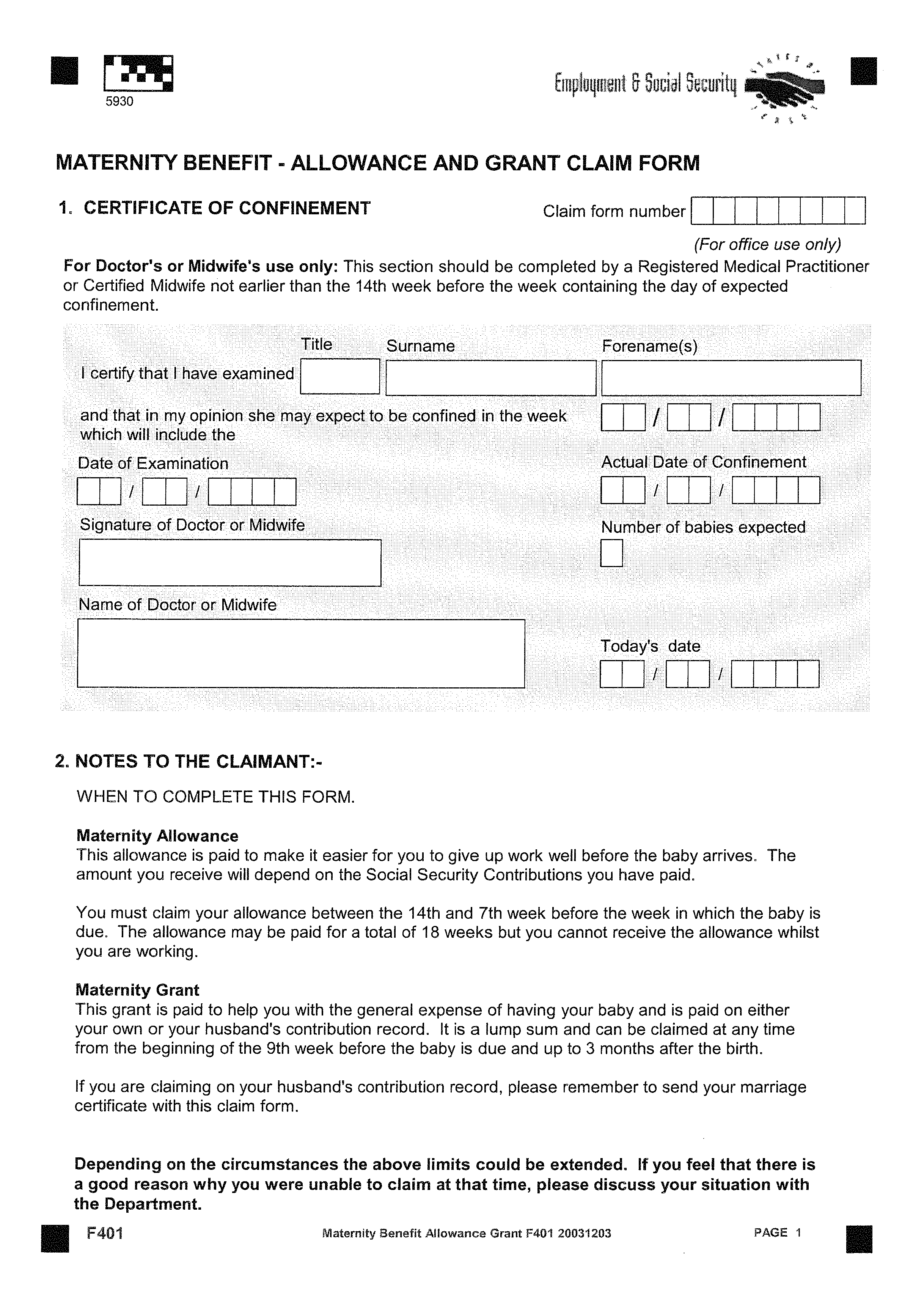
PART
B[10]
EVIDENCE
OF CONFINEMENT